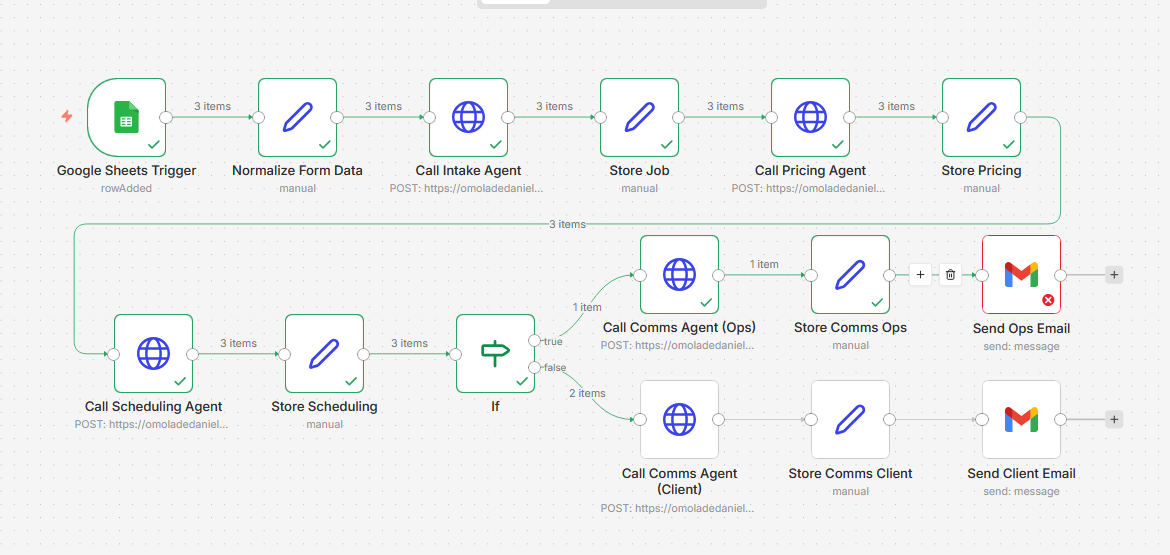
Handyman Ops Desk - n8n Multi-Agent Business Workflow
A no-code multi-agent workflow built in n8n Cloud that automates the front-office of a handyman business from form submission to client confirmation.
Try the Simulation ↗Business Problem
Small home-services businesses lose customers in the gap between request submission and a quote or scheduling reply. The manual triage workflow (read request, estimate, schedule, reply) is slow and inconsistent, and prospective customers move on while staff are still drafting an email.
Tools Used
Key Features
- Form-driven intake from a public Google Form into a watched response sheet that automatically kicks off the workflow
- Gemini-powered extraction of structured job data (service, urgency, address, zip) from free-text submissions
- Rules-based JavaScript pricing engine with catalog lookup by service, zip-aware travel cost, and a 20% rush surcharge for high-urgency jobs
- Live-time slot scheduling that respects customer day preferences
- Routing logic that sends high-priority or high-value jobs (urgency = high or estimate > $300) to operations, and standard jobs straight to a client confirmation email
- Differentiated Gmail templates for client confirmations vs. operations alerts so each audience gets the right message
My Role & Contribution
Sole designer and builder. Architected the orchestrator-plus-four-agents topology, wrote every system prompt, built the JavaScript pricing logic, designed the IF-based routing, and authored the Gmail templates for both client and operations audiences.
Biggest Challenge
Forcing Gemini to return strictly valid JSON. The model kept wrapping responses in markdown code fences (```json ... ```), which broke downstream JSON.parse calls and silently aborted the workflow mid-flow. Solved with strict JSON-only system prompts on every Gemini node, plus a JavaScript Clean JSON node that strips fences before parsing and surfaces a clear error path that preserves the raw model output for debugging.
What I Learned
Agentic orchestration is more about plumbing and contracts than prompts. The hard parts are passing context cleanly between agents, taming non-deterministic outputs (JSON-only prompting plus post-parse cleanup), and choosing where rule-based logic belongs vs. where the LLM should drive. Rule-based deterministic logic (pricing, slot filtering) composes cleanly alongside generative AI (intake parsing, message drafting) in the same pipeline, and these patterns generalize to any LLM-in-workflow project.